
Brunswick Projected and Actual Release
Virginia's official field label is "Projected Release Date." It is an estimate based on controlling sentences and credits as currently calculated. VADOC may account for sentencing documents, jail credit earned before state reception, concurrent or consecutive terms, sentence type, earned-credit class, disciplinary events, and later legal information. That calculation is more than a count of calendar days.
Actual release is the completed movement out of the custodian's secure control. It may lead to full discharge, parole, probation, or another lawful status. A transfer is not community release. Someone who leaves MRRJ for Lawrenceville Correctional Center has departed the regional jail but remains confined by VADOC. Someone whose locator changes from a prison to District 38 may be in the community under supervision, not fully discharged.
A pretrial detainee generally lacks a computed sentence-end date. Bond, a dismissal, a plea, sentencing, another hold, or a later order can change the path. A court order may authorize release while processing, payment, identity checks, property return, or another detainer still prevents physical exit.
Find Brunswick Projected Release Dates
Begin with custody type, not one universal calculator. The VADOC Inmate and Supervisee Locator covers state institutions, people held under VADOC authority, active VADOC supervisees, and CCAP participants. Its result must be read by location and status. For MRRJ, the public JailTracker page is current-custody oriented and does not publish a documented projected-date field or historical release view.
- Identify whether the person is pretrial, serving a local jail sentence, in a VADOC prison, at Brunswick CCAP, or supervised in the community.
- For a VADOC case, accept the locator notice and search with the first three letters of the first name plus the full last name, or use the seven-digit DOC ID.
- Compare identity and DOC number. Read the exact institution, CCAP, or supervision district and any date label displayed.
- For a local sentence, contact MRRJ and ask for the actual jail computation under its written earned-credit policy. Match it to the Brunswick court order.
- For a pretrial case, read the court's bond and later orders. Do not invent a date where no sentence computation exists.
- Near the expected date, ask the custodian whether warrants, detainers, uncalculated terms, or other orders prevent community release.
VADOC says its locator is updated daily but warns that data may be inaccurate or old. A missing result does not establish release. It can mean the case is local-only, identifying details differ, the person is outside current coverage, the record has not updated, or supervision ended.
The Brunswick County released-inmate record path shows how to pair a custody result with the MRRJ entry and court disposition after the projected day passes.
Brunswick NAAVI Release Date Field
The official Virginia NAAVI interface visibly uses the label "Projected Release Date" beside state-custody information such as Custody Status, DOC number, and facility or location details. That sourced label is useful for a VADOC prisoner, including a person at Lawrenceville Correctional Center. NAAVI itself is a victim-notification system with eligibility review, not a general open enrollment release calculator.
The official NAAVI record interface documents where Virginia presents the projected-date label.
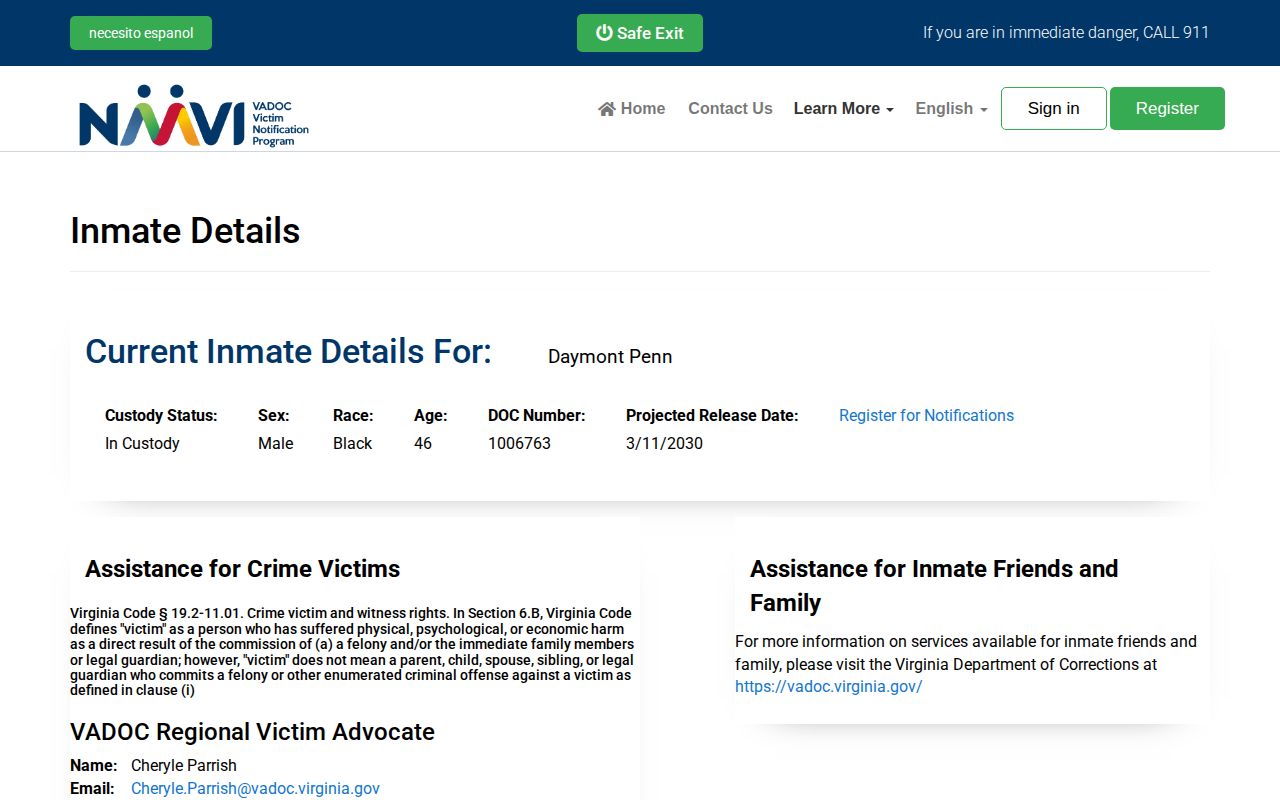
The screenshot establishes the field name, not the actual release of the person used in the example. Personal identity details should never be copied merely to explain how the field works.
When a public result is unclear, VADOC Operating Procedure 050.6 recognizes public inquiry information that can include projected parole eligibility, mandatory-parole and good-time release dates, custody or parole status, and facility location. Ask for the exact public term instead of estimating one.
Note: A future date on an official state screen remains projected until VADOC completes and records the release movement.
Brunswick Earned Release Credits
VADOC's Time Computation information divides applicable sentences between older Good Conduct Allowance rules and Earned Sentence Credits for felony offenses committed on or after January 1, 1995. VADOC calculates a release date for an active Earned Sentence Credit sentence longer than twelve months. The specific offense and effective statute version govern.
Under Virginia Code section 53.1-202.3, enumerated ESC-1 offenses can receive no more than 4.5 credit days for each thirty days served. Other eligible ESC-2 sentences use levels. Level I provides fifteen days per thirty served, Level II 7.5, Level III 3.5, and Level IV zero. Compliance and participation affect classification. Reviews occur at least annually, and specified discipline or program events may support a more immediate change.
Credits can be earned, forfeited, restored, reclassified, or recalculated under governing rules. The current law says classification cannot be lowered and credit cannot be withheld merely because an institution lacks a program, education, or work opportunity. The statute page also contains a future effective version. Current and future text must not be blended.
- Jail credit
- Credit for qualifying confinement before VADOC receives the person, as reflected in the legal and time-computation record.
- Earned Sentence Credit
- A statutory day deduction governed by offense eligibility and assigned credit level.
- Concurrent terms
- Sentences structured to run at the same time, subject to the actual orders.
- Consecutive terms
- Sentences structured to run one after another.
- Detainer
- A request or legal hold that may require transfer or continued custody for another authority.
Brunswick Truth-in-Sentencing Limits
VADOC describes Virginia's 1995 abolition of discretionary parole as requiring at least 85 percent service with traditional good-time credit. That figure is historical shorthand for the 4.5-days-per-thirty structure. It is not a safe universal calculator now. Some eligible ESC-2 sentences can earn fifteen days per thirty, while listed ESC-1 offenses remain capped at 4.5.
Ordinary discretionary parole is generally unavailable for post-January 1, 1995 felonies, but Virginia law includes detailed exceptions. An older offense, a qualifying jury-sentenced case, a qualifying juvenile-offense sentence, or a separate geriatric or medical provision requires its own statutory analysis. Earned credits also do not reduce the waiting period for parole eligibility.
Do not promise exactly 85 percent or apply the best credit rate to every sentence. Offense eligibility, judgment date, credit level, disciplinary history, sentence papers, jail credit, and later adjustments control the projected date. The time-computation unit, not an informal arithmetic estimate, supplies the state calculation.
Brunswick Jail Release Computation
A Brunswick County person serving a local sentence at MRRJ does not automatically use VADOC's long-felony calculation. Virginia Code section 53.1-116 requires the jailer to maintain a written earned-credit policy and underlying prisoner records. Ask MRRJ for the actual computation and the policy applied to that sentence.
The court order, applicable jail credit, local earned-credit policy, holds, and administrative record govern. MRRJ publishes no official release hour, weekend or holiday release rule, or projected-date interface. Do not copy the state-prison rule that a release occurs by a stated outside time to the regional jail. The two custodians use different procedures.
Meherrin River Regional Jail
9000 Boydton Plank Road
Alberta, VA 23821
434-949-6700
MRRJ records and FOIA information
For a pretrial detainee, ask the Brunswick court about bond and later orders, then ask MRRJ whether the person physically left. An entered bond order can precede payment, surety review, identity checks, property return, another hold, or transport. It is authority for the next step, not a guaranteed door time.
What Changes Brunswick Release Dates
VADOC conducts final checks before release. Operating Procedure 050.3 calls for review of warrants, detainers, court orders requiring continued custody, discipline or classification actions that affect time, and sentences not yet calculated. A parole grant adds planning and formal release documents. Any one of those items can separate a projected date from the final movement.
| Factor | Possible effect | Best record |
|---|---|---|
| Credit classification | Changes the rate at which eligible sentence credit is earned | VADOC time computation and current statutory class |
| Discipline or forfeiture | Can reduce or delay credits under governing rules | Final VADOC calculation |
| New sentence information | Can add or restructure concurrent or consecutive time | Court orders and VADOC computation |
| Warrant or detainer | May prevent community release or cause transfer | Holding authority and final custody record |
| Continued-custody order | Requires confinement beyond an earlier estimate | Controlling court order |
| Parole action | A grant may begin planning but does not fix the exit minute | Board decision, grant letter, and release papers |
If a projected day passes while the locator still shows a prison, do not label the custody unlawful or the public screen wrong. Ask VADOC's Court and Legal or Correspondence Unit for the current public computation. The cause may be recalculation, a hold, an uncalculated sentence, or display lag.
Note: Never add or subtract credit days independently when the controlling sentences, eligibility class, and holds have not been verified.
Virginia's Thirty-Day Release Window
Virginia Code section 53.1-28 allows the VADOC Director, for prerelease scheduling and conditioning, to discharge a state prisoner within the thirty days before the term would otherwise expire. This is a limited state-prison scheduling authority. It does not give every person an automatic thirty-day reduction, and it does not override final warrant, detainer, sentence, discipline, or court-order checks.
The rule also does not belong to MRRJ. No sourced Brunswick regional-jail weekend-release or comparable early-discharge rule was found. A local sentence must be checked under MRRJ's written earned-credit policy and the actual court and jail computation. Borrowing the VADOC flexibility for a county-jail case would create a false date.
This Virginia-specific window helps explain why a projected date is not a fixed countdown. Administrative planning can affect the scheduled state release within statutory bounds, while later legal facts can block community release. The final state movement and signed papers resolve which path occurred.
Confirm Brunswick Actual Release Dates
Close the inquiry with the custodian. For MRRJ, request the cumulative booking and release entry and ask whether the departure was community release or transfer. For Lawrenceville or another state prison, use the final institutional movement, notification-of-release letter, and any signed Order of Release, Conditions of Probation, or Conditions of Parole.
Notification can provide timely corroboration. Virginia VINE serves local and regional jail custody, while VADOC prison notification moved to NAAVI for approved eligible registrants. The registrations do not transfer. The Brunswick VINELink release check explains the local-jail alert and PIN process. An alert should still be verified against the originating record.
Keep each date labeled. A court order date, parole decision, projected release date, certification date, MRRJ exit time, VADOC discharge date, and later supervision discharge can all be different. Clear labels preserve the custody chain and prevent a transfer or planning estimate from being reported as completed release.
Public Record Search
Sponsored Results